

The Tonle Sap (Tonlé Sap, or Boeung Tonle Sap, the Great Lake in Khmer) is the largest freshwater lake in Southeast Asia, a UNESCO biosphere reserve, and the reason Cambodia has had an abundance of rice and fish for thousands of years. It is, in a sense, the dumping point for the Mekong River: every monsoon the swollen Mekong forces the Tonle Sap River to flow backwards, pushing water, silt and fish north into the lake until it has grown about five times over. More than a million people live on and around it, in villages that float, stand on stilts, or do both depending on the month.
- Dry season size
- About 2,500–3,000 km², under 1 m deep
- Wet season size
- 11,000–13,000 km², up to 9 m deep
- River reverses
- June to October
- People on the lake
- More than a million
- Fish in the diet
- About three quarters of Cambodians' animal protein
- From Siem Reap
- 15 to 50 km
How the lake works
The Tonle Sap River connects the lake to the Mekong at Phnom Penh. For most of the year it drains the lake south. When the monsoon swells the Mekong faster than the delta can carry it away, the river backs up and turns around, pushing Mekong water, silt and fish eggs north into the lake. The lake rises by up to nine meters and drowns the forest around its shore. In November the Mekong drops, the river turns south again, and the Water Festival in Phnom Penh marks the moment. See the Tonle Sap water level today, with a daily chart.

The lake, month by month
What you see depends more on the month than on the village. The table is how our guides describe a typical year; sunset times are for Siem Reap. These are estimates: the lake varies from year to year with the rains, the dams upstream on the Mekong, climate change and other factors. They are good indicators, and you can always message us for an up-to-date report on what the lake is doing right now.
| Month | Water | Villages | Canoe | Sunset | Light |
|---|---|---|---|---|---|
| January | high, dropping | floating | Running | 17:50 | clear skies, warm gold at sunset |
| February | dropping | stilts showing | No | 18:05 | dry, hazy afternoons |
| March | low | on stilts | No | 18:12 | hot, hazy |
| April | lowest | on stilts | No | 18:15 | hot, hazy |
| May | low, first rains | on stilts | No | 18:20 | big clouds, dramatic sunsets |
| June | rising | on stilts | No | 18:28 | green countryside, afternoon showers |
| July | rising fast | water at the stilts | Running | 18:30 | lush, stormy skies |
| August | high | floating | Running | 18:20 | lush, stormy skies |
| September | high | floating | Running | 18:03 | clearing, soft light |
| October | highest | floating | Running | 17:45 | clear, best of the year |
| November | high, Water Festival | floating | Running | 17:35 | clear, cool evenings |
| December | high, dropping | floating | Running | 17:38 | clear, cool evenings |


Who lives on the lake
Fishing families, mostly Khmer, with Vietnamese and Cham communities in the houseboat villages. Many ethnic Vietnamese families moved onto the lake after Vietnam drove the Khmer Rouge from power in 1979, and their descendants still live in floating communities on the open water. There are hundreds of these boat communities, constantly moving with the water, which NGOs such as Wetlands Work have documented. The catch feeds the country; the fish paste, prahok, that flavors Cambodian cooking comes from here. In the dry season many families farm the land the water leaves behind. Children paddle to school. Pagodas, markets and clinics stand on stilts or float. It is a working landscape, and the villages that do best are the ones where tourism is a side income rather than the main one.

Most families on the lake live from fishing, and nets are the most common way to do it: cast nets thrown by hand from a small boat, and long gill nets set overnight between bamboo poles and pulled in at dawn. A net is a family's main tool, and it takes constant care, because fish, branches and other debris in the water tear holes in the mesh. On any village tour you will see someone sitting under the house mending one, knot by knot.


The villages
Four villages near Siem Reap take visitors: Kompong Phluk, Kompong Khleang, Mechrey and Chong Kneas. They differ in distance, crowds, price and what you actually see. Our comparison is the place to choose; the short version is Phluk for the flooded forest, Khleang for authenticity, Mechrey for quiet, and Chong Kneas only if you have an hour.
What it costs to visit the lake
The lake is reached through several ports at the Siem Reap floating villages: Kompong Phluk, Kompong Khleang, Mechrey and Chong Kneas. Generally speaking, it is free to simply visit. You will most likely be asked for the USD 2 tourism tax, and there can be confusion at the gate, so be clear that you are there to look around and not to take a boat tour.
That said, without a boat you will be limited in what you can see. When the water is high you cannot get close to the houses at all, because the village is in the water. So a boat tour is highly recommended. Community boat tickets are USD 20 per person plus the USD 2 tourism tax at Kompong Phluk and Kompong Khleang, USD 22 per person at Mechrey, and USD 7 at Chong Kneas with a four-ticket minimum; the flooded forest canoe is USD 5 to 10 on top. Our group sunset tours are $28 and $35 with everything included, and a private day is $145 for up to four. See which village to choose and every fee, village by village.
See it with someone who lives there
Our guides were born in Kompong Phluk and Kompong Khleang. The tours use the community boats and pay the community price. Join the daily Kompong Phluk or Kompong Khleang sunset tour, see all the Tonle Sap tours, or tell Design your Day what matters to you and assemble your own afternoon.


Kompong Khleang at high water: the flooded forest and the floating villages
We had a tour to Kompong Khleang today, and the high water made it a special one. With the lake this full we were able to see not only the flooded forest but also travel by boat right through the floating villages.
We set out on the community tourism boat, and from there we transitioned into a row boat with a lovely lady from Outaput village, who was so happy to host us.
Out among the floating houses, one of our videos caught a lovely moment: a dog swimming across the lake to his home. Life here really does happen on the water.
There is also a great view of the glimmering Buddha at Wat Khleang, standing tall above the water as the boats pull in below.
November is a wonderful time to see Kompong Khleang. If you would like to plan a day like this one, you can design your own private day or join our Kompong Khleang sunset group tour.

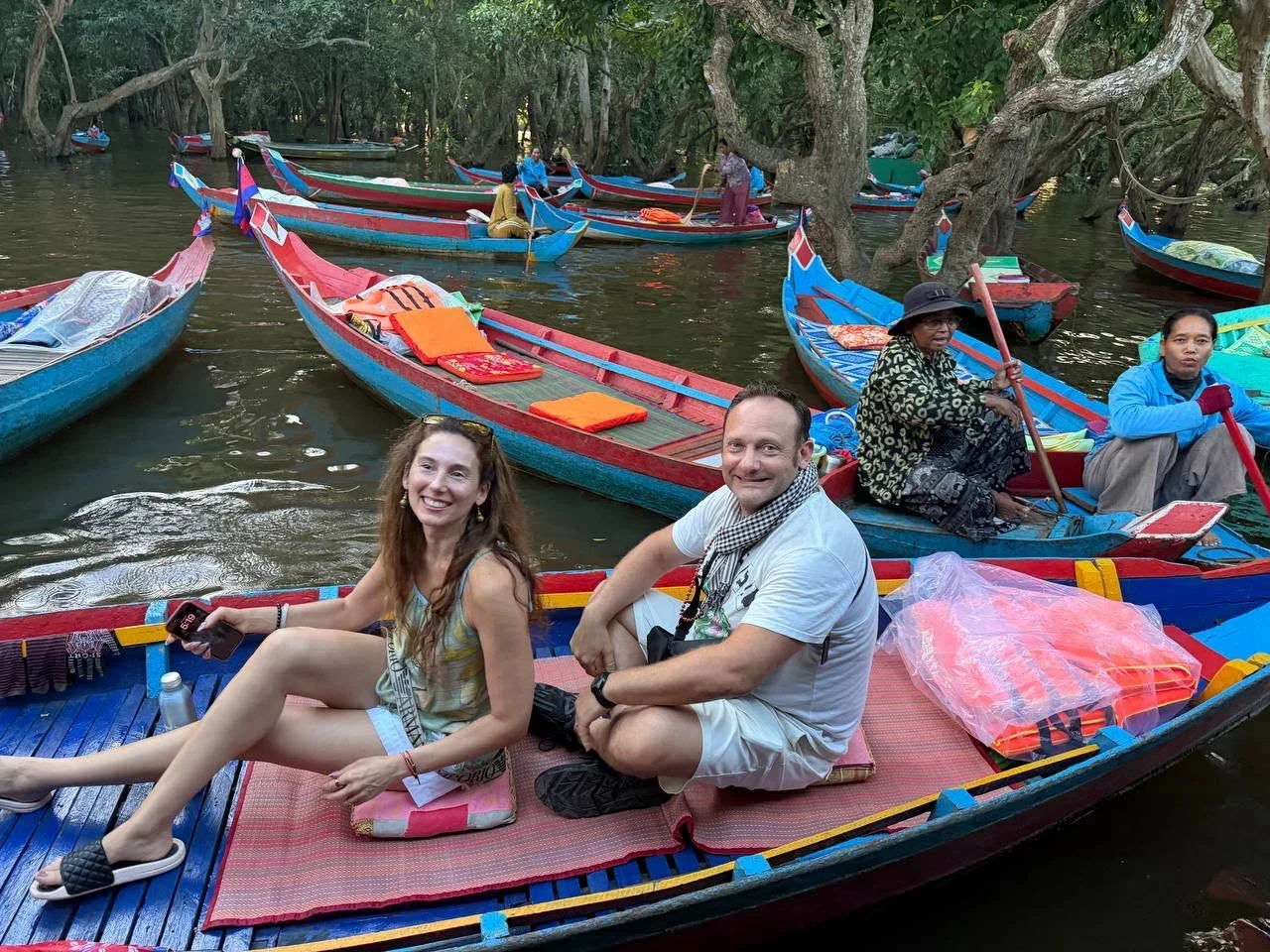

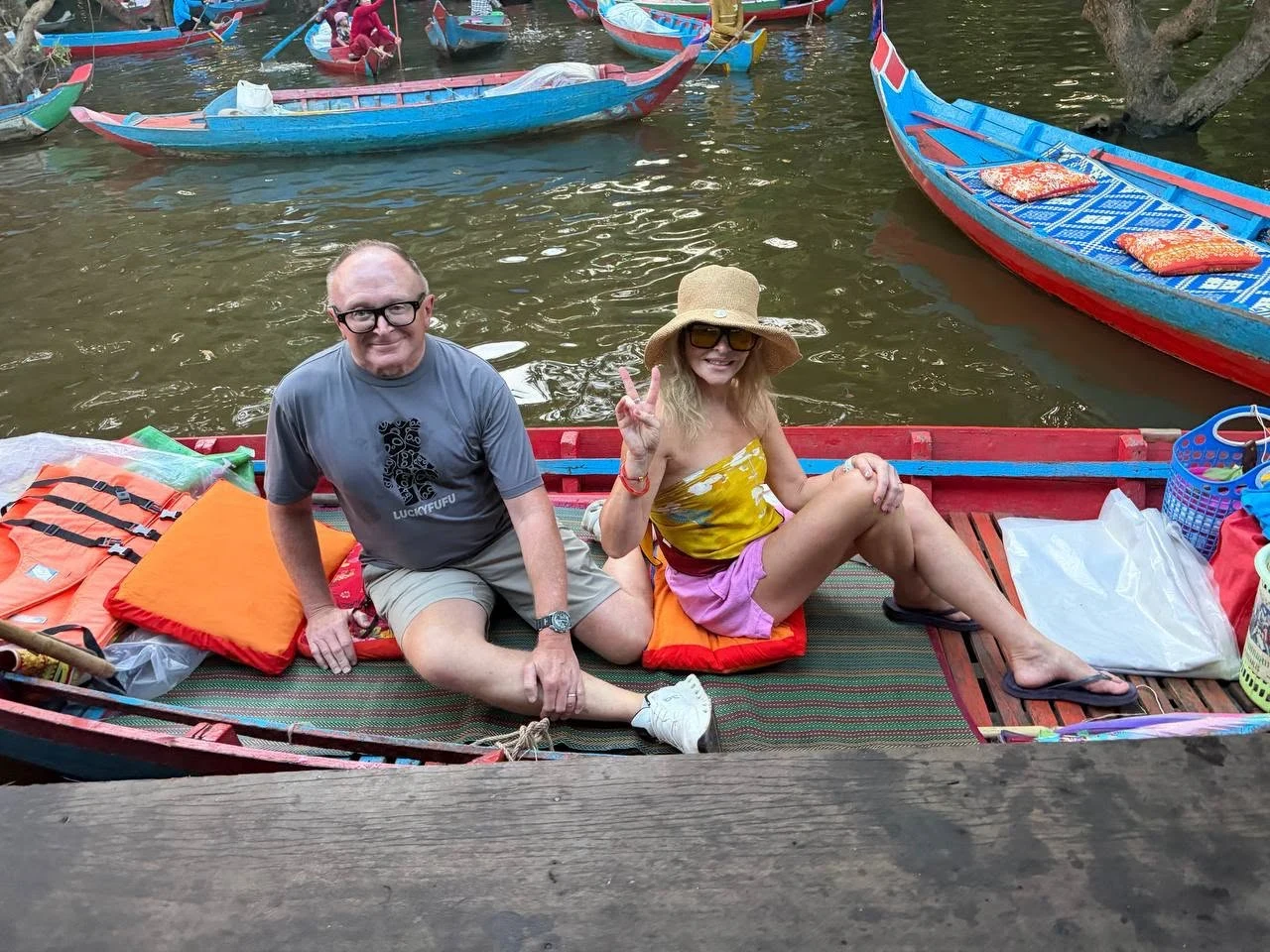

High water, no queue for the flooded forest, and a flawless sunset at Kompong Phluk
Yesterday’s Kompong Phluk Sunset Tour had everything going for it. The water is still high, up near the floors of the stilt houses, so the boat goes right between the homes and the whole village sits in the lake.
It was not too crowded, and there was no wait at all for the flooded forest: our guests stepped straight off the community boat into the rowboats and were paddled out between the trees. The weather was great all afternoon, and the sunset on the open lake was flawless.
If you are deciding when to come: early November is about as good as it gets at Kompong Phluk. The forest is still fully flooded, the rains have eased, and the skies are clearing for sunset.
Frequently asked questions
Where is Tonle Sap Lake?
In the center of Cambodia, south of Siem Reap and north of Phnom Penh. The nearest shore to Siem Reap is 15 km away at Chong Kneas; the villages worth visiting are 30 to 50 km from town.
Why does the Tonle Sap River reverse?
In the monsoon the Mekong rises faster than the lake can drain, so water is pushed back up the Tonle Sap River into the lake. From roughly June to October the river flows north; when the Mekong drops, it turns around and flows south again.
How big does the lake get?
From about 2,500 to 3,000 square kilometers and under a meter deep at its lowest, in the dry season, to between 11,000 and 13,000 square kilometers and up to nine meters deep at its peak, in October, according to the Mekong River Commission. The forest around it floods for months.
What does Tonle Sap mean?
Roughly "great lake" or "large freshwater river" in Khmer. Cambodians usually call it Boeung Tonle Sap, the Tonle Sap Lake, and the river that joins it to the Mekong is the Tonle Sap River.
Can you visit Tonle Sap in the dry season?
Yes. The villages are still there and still fascinating; the stilt houses stand ten meters above dry ground, the boat ride to open water is longer, and the flooded forest canoe does not run. The best months for the full floating effect are August to early December.
How far is Tonle Sap from Siem Reap?
The nearest point, Chong Kneas port, is about 15 km and about 20 minutes. Kompong Phluk is 31 km and 45 to 60 minutes; Kompong Khleang is 50 km and 60 to 75 minutes; Mechrey is about an hour. All of our tours include hotel pickup.
What is the flooded forest?
The belt of trees around the lake that stands in water for half the year. From about July to January the lake rises up the trunks and you can be paddled between the trees in a rowboat; by April the same trees stand on dry ground. Kompong Phluk has the most easily accessible flooded forest near Siem Reap; the forests around Kompong Khleang are much bigger, and much quieter. Our guide to the flooded forest has the details.
How much is the Kompong Phluk boat ticket?
USD 20 per person for the community boat, plus a USD 2 tourism tax, and USD 5 per person for the flooded forest rowboat. The same boat ticket and tax apply at Kompong Khleang, where the canoe is USD 10. All of our tours include the boat tickets.
Can I stay overnight on Tonle Sap Lake?
Yes. There are homestays at Kompong Khleang and Kompong Luong, and the Kompong Khleang ones in particular can be booked online. The lake also works as a route: our private boat crossings to Battambang and Kompong Luong let you spend a whole day on the water and arrive somewhere new. Ask us on WhatsApp and we will put a plan together.
Can you swim in Tonle Sap?
Locals do, and many of our guests have too. It is fun and worthwhile when the water is high, from about July to January. In the dry season, as the water recedes, there is a higher concentration of bacteria, because there is no rain to dilute the lake and the Mekong is no longer pushing fresh river water in. So in the dry season we don't recommend swimming. We never recommend drinking the water. Locals do, and when the water is high you generally won't get sick from it, but as the water recedes it should always be filtered. Bottled water is provided on all our tours.
Is a Tonle Sap tour worth it?
Yes, it is definitely worth doing. Part of traveling is visiting places you cannot experience back home, and the floating houseboat communities of the Tonle Sap, a UNESCO biosphere reserve, are one of them. That said, the experience is much better with a well-organized tour, and having a guide from the village gives you an insight you will not get any other way. That is why we recommend seeing it on a group or private tour.