

What is the best Siem Reap floating village? That's a really important question to ask yourself when you have limited time in Siem Reap. There are four floating villages within reach of Siem Reap on Tonle Sap Lake: Kompong Phluk, Kompong Khleang, Mechrey and Chong Kneas. They have real differences that you should keep in mind when making your choice.
Below we compare them on some of the things we think matter most: authenticity, how much there is to see, convenience and time, size, the number of other sightseers, and other factors travellers take into consideration when planning their trip. We hope it helps you decide which is the best floating village for you.
Got questions? Don't hesitate to message us on WhatsApp, or let us take the lead and create the perfect experience for you.

| Item | Kompong Phluk | Kompong Khleang | Mechrey | Chong Kneas |
|---|---|---|---|---|
| From Siem Reap | 31 km · 45–60 min | 50 km · 60–75 min | About 60 min | 15 min |
| What it is | Stilt village, easily accessible flooded forest | Ten stilt villages, two houseboat communities | Small floating village with a floating school and church | Floating village next to the port |
| Boat | USD 20 + USD 2 tourism tax | USD 20 + USD 2 tourism tax | USD 22 per person | USD 7 ticket, 4-ticket minimum |
| Flooded forest canoe | USD 5, July–January | USD 10, private tours only | None | None |
| Tourists | Many | Few | Very few | Many |
| Our tours | Group $28 · private | Group $35 · private | Private only | Not offered |
You'll see these names spelled different ways: Kampong Phluk or Kampong Pluk, Kampong Khleang, Me Chrey, Chong Khneas. They're the same places.
Where the villages are
The Siem Reap floating villages compared
Time and duration
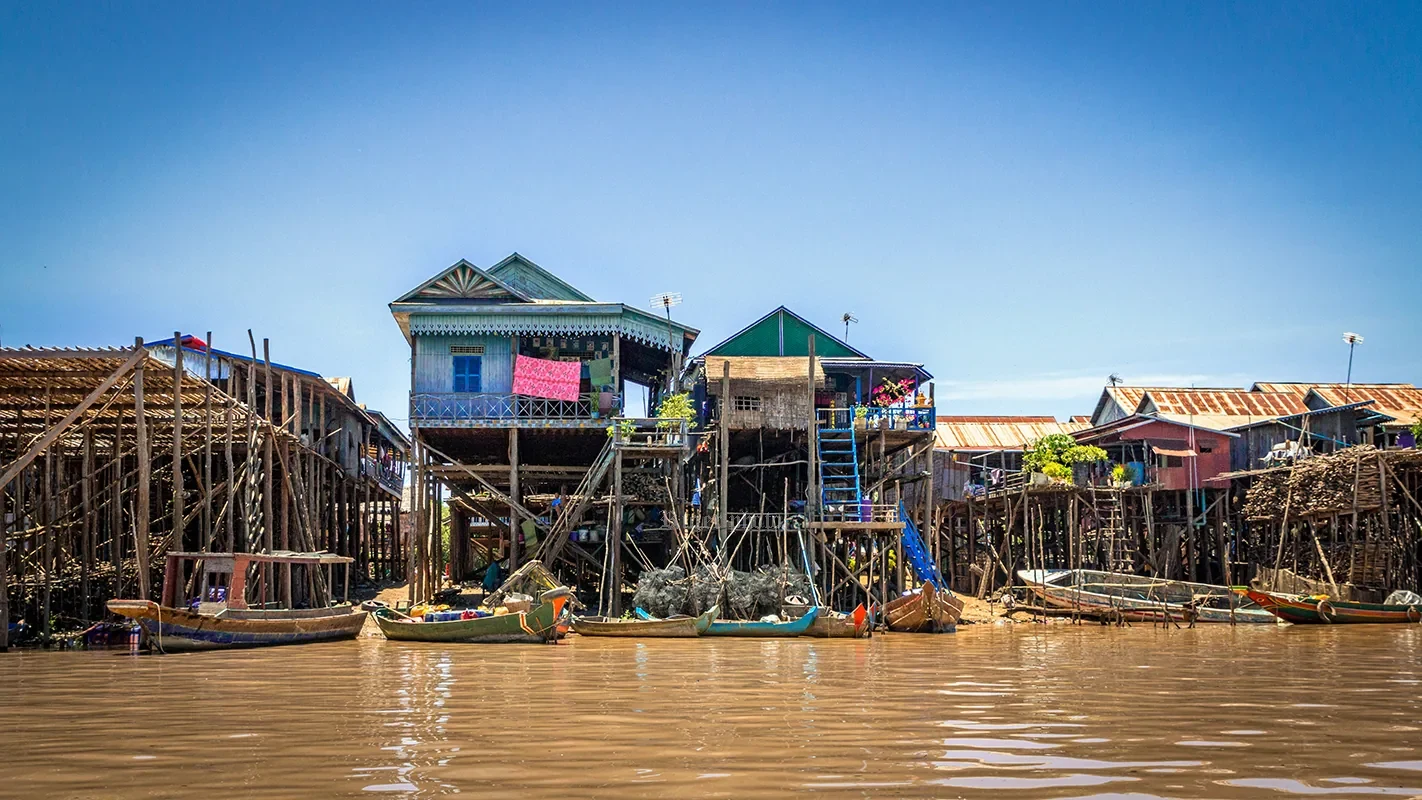
When you only have a short time in Siem Reap, timing is everything. There are so many things to do and see, and you want to pack in as much as possible. With that in mind, one of the big advantages of Kompong Phluk is that it is the closest real floating village to Siem Reap. Depending on the water level it can be less than an hour's drive. The village is smaller, so the boat ride is shorter and you reach the Tonle Sap faster. The tour itself, including the flooded forest, takes around two hours (not counting waiting for sunset or stopping for a meal), so you can comfortably be back in Siem Reap in four. That leaves the whole morning or afternoon for the rest of what the city has to offer.
Kompong Khleang is about 50 kilometres from Siem Reap, at least an hour by car. You can go by tuk-tuk, but we don't recommend it for the distance: a car costs only slightly more and saves a lot of time. It is also a much larger village, so the boat ride is longer, especially in the dry season when the boats go slower, and seeing the village and going out onto the Tonle Sap can take up to two hours. Budget around five hours for Kompong Khleang if you want to make food stops on the way, and about five and a half if you also want to enjoy the sunset. Despite the distance, it is worth the extra hour to see the largest floating village on the lake. Our Kompong Khleang sunset tour leaves at 2:00 pm and takes about five and a half hours. Mechrey is about an hour's drive, similar to Kompong Phluk.
If you really only have an hour or two, Chong Kneas is the closest of all, fifteen minutes from town. But it is also the busiest, and it gives you the least of village life.
Winner Kompong Phluk
Curious what a Kompong Phluk tour looks like? See our latest trip report →
Everything else you need to know is in our Kompong Phluk guide.
"Authenticity"

This one is important, but also a little subjective, which is why it is in quotation marks. Part of the fun of a floating village tour is seeing a real, undisturbed village. It doesn't feel as authentic when you see English signs and tourist businesses selling cheap souvenirs. That is why Kompong Khleang wins the authenticity debate hands down: it simply has very little tourism infrastructure. There are no restaurants serving Western food, no one selling souvenirs, and the boat drivers don't speak English. You feel like you are passing through a village as people carry on with their daily lives. Residents will be fishing, doing laundry and tending their fish farms whether you are there or not. Despite this, there are still local sellers where you can grab a cold drink or use a toilet.
Mechrey is a close second for authenticity. The trip there through the countryside is picturesque, but we still prefer Kompong Khleang, as it is much larger.
Winner Kompong Khleang
Curious what a Kompong Khleang tour looks like? See our latest trip report →
Planning a visit? Read our full guide: Visiting Kompong Khleang? Read this first.
The flooded forest

One of the biggest draws of a Tonle Sap floating village tour is the flooded forest. Locals use it to fish for shrimp and cut the trees for firewood, and it is a wonderful place to experience by boat. A local paddles you through the trees in a small rowboat, past massive trunks and shrimp traps, and if you are lucky some wildlife. The canoe runs from about July to January, when the water is high enough.
Kompong Phluk is the village best known for its flooded forest. The canoe there lasts about 30 minutes and costs USD 5 per person, and it is included on our Kompong Phluk sunset tour and our private days to Kompong Phluk. In the high season, though, you sometimes have to wait in a queue for a canoe.
You can do it at Kompong Khleang too, on a private tour (USD 10 per person). Unlike Kompong Phluk, Kompong Khleang has several flooded forests, and you will have them to yourselves, with no other tourists in sight. More in our guide to the flooded forests.
Winner Kompong Phluk
Size and sightseeing

One of the starkest contrasts between the two is size. Kompong Phluk is home to around 3,000 people, which is why tours spend less time in the village. Kompong Khleang is home to around 14,000.
Because Kompong Khleang is so much bigger, you see more. Kompong Phluk has one pagoda; Kompong Khleang has four, and it is home to the tallest Buddha statue in Siem Reap, which we call the Glimmering Buddha for its vibrant tiles. There are more homes, a large market, and two houseboat communities out on the open water, Khmer and ethnic Vietnamese. On the way there you can stop for bamboo sticky rice from a village famous for it, and a countryside bakery, both of which are past the turn-off for Kompong Phluk.

Your visit also helps. Kompong Khleang's community tourism tax goes back into the village, and in recent years it has helped pay for real improvements: more of the road is now paved, and the village is much better lit at night. It has been really meaningful for us as guides to see all these improvements over the past ten years, thanks to travellers like yourselves.
Winner Kompong Khleang
The countryside

For many visitors, the drive out to a Siem Reap floating village is half the experience. If you want to spend real time in the countryside, Mechrey is the one. The road there runs through rice paddies, past water buffalo, ox carts and small farming villages, and the landing is far from the tour buses. You will usually have the village to yourselves. Kompong Khleang is a close second, with a long countryside drive and the sticky rice village and bakery on the way. Kompong Phluk's road is shorter and busier, and a trip to Chong Kneas, on the edge of town, has no countryside at all.
Winner Mechrey
The quickest visit on your own
If you have an hour, don't want a tour, and just want to see a floating village near Siem Reap, Chong Kneas is the simplest. It is fifteen minutes from town, and since 2022 the boats have been run by Angkor Enterprise with a fixed USD 7 ticket and a four-ticket minimum per boat. It is the busiest of the four and the most set up for tourists, and you can do it easily by yourself. Honestly, though, we can't recommend it: we have met so many travellers who were disappointed with the time they spent there. If you do go, our honest guide tells you how.
Winner Chong Kneas
So which is the best?

So which is the best floating village in Siem Reap? For us, having spent so much time in these communities, Kompong Khleang is the winner hands down. It is the biggest and most authentic village on the lake, the drive takes you through the countryside and past the sticky rice village, and your visit supports real community development. Our Kompong Khleang guide has everything you need to plan the visit.
But Kompong Phluk and Mechrey have their strengths as well. If you are here for a shorter time, want the more affordable option, and would like to see the flooded forest, Kompong Phluk is a great choice. If you want quiet, rice paddies and water buffalo, and a village with almost no other visitors, choose Mechrey.
Or design your own private day: tell us what matters to you, and it will suggest a village, build the day hour by hour and show you the price.
More on Mechrey and Chong Kneas
Mechrey

Mechrey (sometimes written Me Chrey) is a small floating village on the northern shore of Tonle Sap Lake, south-west of Siem Reap in Puok district, about an hour's drive from Siem Reap. It is also the boat landing for Prek Toal and its bird sanctuary, so if you are planning a trip to Prek Toal, this is where your boat leaves from.

Unlike Kompong Phluk and Kompong Khleang, which are built on stilts, Mechrey is a true floating village: the houses, a small floating school, a floating church and the shops sit on rafts and boats, and the whole village moves with the water as the lake rises and falls through the year. Families fish and run small shops from their boats, and very few tourists come this way.
The drive out runs through some of the prettiest countryside near Siem Reap: rice paddies, water buffalo and farming villages, with no tour buses on the road. The boat trip is run by the local community, Mechrey Nature Community, and costs USD 22 per person, and a canoe between the floating houses is USD 10 per person. We run Mechrey as a private tour, with your own guide and air-con car, from $145 for up to 4 guests. If you want a quiet, untouched floating village and a real taste of the Cambodian countryside, Mechrey is a great choice.
Chong Kneas

Fifteen minutes from town, next to the ferry port, and the village most tuk-tuk drivers will take you to. The official ticket covers everything you need, so we don't run tours there; our honest guide shows you how to do it on your own. Read our honest guide.
A shout-out: Pearaing
Not a floating village, but worth a mention for nature lovers. The Pearaing Biodiversity Conservation Center is a bird sanctuary close to Siem Reap, reached by boat through the flooded landscape at the edge of the lake. From about January to June, as the water drops, many of the waterbirds from Prek Toal come here by day to feed in the shallows, before flying back to Prek Toal for the night: storks, pelicans, ibis and more. It isn't a floating village, but it does have a lovely boat experience, and it's a closer alternative to Prek Toal for birdwatching in the first half of the year. Pearaing isn't always open, so contact us directly and, if it's open on your dates, we can arrange a tour for you.
Beyond Siem Reap

We also have representatives at Prek Toal, the bird sanctuary and floating village on the Battambang side of the lake, a private full day from Siem Reap, and at Kompong Luong, the floating town on the southern shore in Pursat, which you can reach on our boat across the lake.
Still not sure which floating village to visit?
Tell us what matters to you, whether that's authenticity, the flooded forest, time, quiet, birds, foodie stops or a countryside market, and Design your Day will suggest a village and put together your floating village tour, with times and the price. If you already know, the daily Kompong Phluk and Kompong Khleang sunset tours and every private day are on the tours page.
Frequently asked questions
What is the best floating village in Siem Reap?
For us, Kompong Khleang, hands down: the biggest and most authentic village on the lake, with the countryside and the sticky rice village on the way. Kompong Phluk is the better choice if you are short on time and want the flooded forest, and Mechrey if you want quiet countryside with almost no other visitors.
Kompong Phluk or Kompong Khleang?
Kompong Phluk wins on time (about four hours door to door) and on the flooded forest. Kompong Khleang wins on authenticity and on size: around 14,000 people, four pagodas, a market, two houseboat communities and the sticky rice village on the road there.
Is there a floating market in Siem Reap?
Not in the sense of boats selling to tourists, as in Thailand or Vietnam. Most of the floating villages have a main market that the villagers visit, and at Kompong Khleang there is a large one. But there are also many sellers who take small boats and shuttle around the homes: if you live in a floating house you simply wait for the boat to stop by and buy your eggs, vegetables and other essentials. You will see these boats on a village tour; our floating market guide has more.
Which floating village is closest to Siem Reap?
Chong Kneas, about 15 minutes. Kompong Phluk is 45 to 60 minutes, Mechrey about an hour, Kompong Khleang 60 to 75 minutes.
Are the Siem Reap floating villages really floating?
Kompong Phluk and Kompong Khleang are mostly on stilts, up to ten metres tall, with the water rising to the floors in the wet season. Kompong Khleang also has two true houseboat communities, and Mechrey and Chong Kneas are houseboat villages that move with the water.
How can I visit the floating villages responsibly?
Pay the community boat ticket, which funds the village, and buy your drinks and snacks from the local sellers. Ask before photographing people, and go easy on close-ups of children. Please don't hand out money or sweets to kids, and skip the school visits, which keep children out of class; our guide on why we don't stop at the school explains. Wear the life jacket when the crew asks. And read our guide to the floating village scams so your money goes to the village, not a middleman.
When is the best time to visit the floating villages?
August to early December, when the water is high and the forest is flooded; there is still plenty of water for a few months either side, and the canoes run from about July to January. The dry season is a different, drier village, interesting in its own way.