
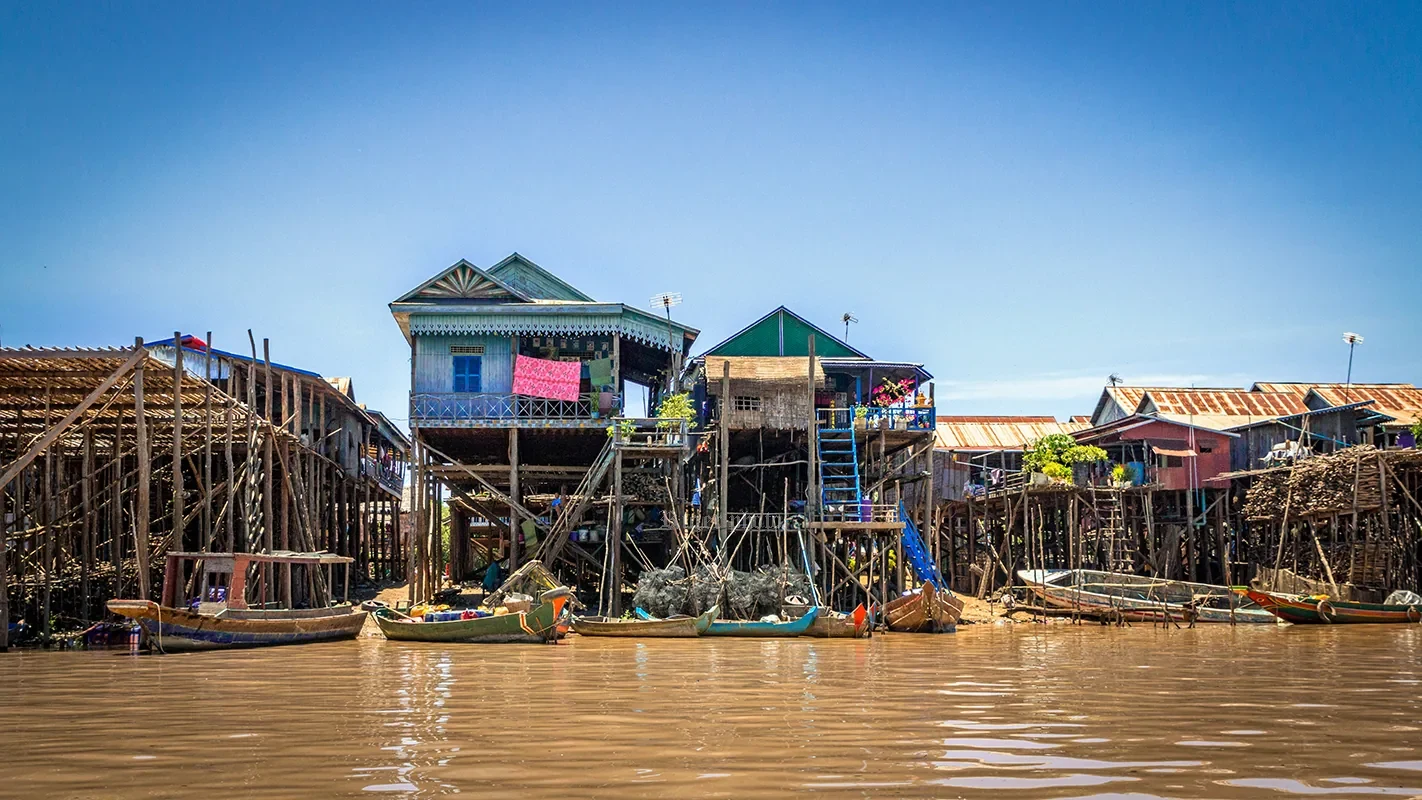
Kompong Phluk (also spelled Kampong Phluk or Kampong Pluk) is a village of about 3,000 people built on stilts up to 10 meters tall on the edge of Tonle Sap Lake, 31 km from Siem Reap. For half the year it sits above dry ground; for the other half the water rises to the doorsteps and the surrounding mangrove forest floods. It is the closest thing Siem Reap has to a real floating village that still lives by fishing rather than by tourism, and it has the most easily accessible flooded forest near Siem Reap.
- Distance
- 31 km · 45–60 min
- Village boat
- USD 20 per person plus a USD 2 tourism tax
- Forest rowboat
- USD 5, July–January
- Population
- About 3,000
- Best months
- August – early January
- Our tour
- $28 · daily 2:00 pm
This guide covers what the village is, how to get there, what the boats cost, when to go, and how to make the most of your visit. We run tours here daily; our guides grew up in Kompong Phluk and Kompong Khleang.
What is Kompong Phluk?
Kompong Phluk is three neighboring villages on a channel that runs into Tonle Sap Lake, about 16 km southeast of Siem Reap as the crow flies (31 km by road). About 3,000 people live here, almost all of them fishing families. The houses stand on wooden stilts six to ten meters high. In the dry season you walk beneath them along a dusty road; in the wet season the road disappears and the village is reached by boat.
What makes Kompong Phluk different from the other villages near Siem Reap is how easy its flooded forest is to reach. The mangroves surround the village and flood every year, and the community protects the part of the forest used for its canoe tours. Elsewhere, cutting mangroves for firewood is still common, though the government has been doing a better job of preventing deforestation, because the forest is home to birds and wildlife and is important for shrimp fishing. The whole area is part of the Tonle Sap Biosphere Reserve, recognized by UNESCO for its fish, birds and plant life.

A short history
Kompong Phluk was a fishing village long before 1975. Under the Khmer Rouge it was burned down, as Kompong Khleang was, and the people were moved inland to farm rice. After the regime fell they came back and rebuilt their homes on the same stilts and channels. Conditions improved in the 1990s when aid organizations built roads and schools and taught conservation alongside fishing. From the 2000s the villagers, with the help of GIZ and other aid organizations, set up their own community tourism cooperative, which now runs the boats you will ride. GIZ was instrumental in developing community-based tourism across the floating villages.
How to get to Kompong Phluk
Take National Road 6 east towards Phnom Penh, turn right at Bakong (there is a signpost), and follow the road south to the boat landing. By car or minivan it takes 45 minutes to an hour depending on traffic and the water level; a tuk-tuk takes longer and is hot and dusty in the dry season. In high water the last stretch of road is under the lake and the boat leaves from further north, so the landing moves with the season: the drive is slightly shorter when the water is high and slightly longer when it is low.
Most visitors come with a tour because the boat ticket, the forest rowboat and transport add up to roughly the same as a guided trip, and a guide from the village can tell you what you are looking at. That also means no haggling and no communication problems. If you do come on your own, see our entrance fee guide for what to expect at the ticket office.
The flooded forest
The flooded forest is the reason to choose Kompong Phluk over Mechrey or Chong Kneas. Kompong Khleang has one too, but it costs more to visit. After the village boat passes the last houses, you transfer to a wooden rowboat paddled by a village resident, usually a woman from the rowing cooperative, and spend around 30 minutes gliding between submerged tree trunks. It is quiet, shaded and unlike anything else near Siem Reap. The rowboats run from roughly July to January, when the water is deep enough; outside those months you can still see the forest from the walkway and the main boat.


Kampong Phluk boat prices and tickets
There are two boats, and two tickets, sold by the community cooperative:
| Boat | Price | Duration |
|---|---|---|
| Village boat: landing, through the village, out to the lake and back | USD 20 per person plus a USD 2 tourism tax | About 1 hour |
| Flooded forest rowboat (optional) | USD 5 per person | 20–30 minutes |
Our tours include both tickets in the price. If you are quoted more than this at the landing, you are most likely being charged by a middleman; see our guide to floating village scams.

Best time to visit
The lake rises from under a meter deep in the dry season to up to 9 meters at its peak in October. Kompong Phluk is at its best from August to early December: houses stand in water, the forest is flooded and the rowboats run. But Kompong Phluk is worth visiting any time of year. There are boat rides all year round, and in the dry season, from February to May, you see just how high the homes stand on their simple wooden stilts. It is also the time for a walking tour through the village, when you can really meet and talk with the people who live there. Sunset is spectacular all year.

Visit Kompong Phluk with us
We have run tours to Kompong Phluk since 2017. Our guides come from the lake villages, speak fluent English, and know the families you will pass. Two ways to go:
| Item | Group sunset tour | Private tour |
|---|---|---|
| Price | $28 per person | $145 for up to 4 people, then $25 per extra person |
| Departs | Daily 2:00 pm, back about 7:00 pm | Any time; mornings see the village at work, afternoons get the sunset |
| Includes | Hotel pickup in an air-con vehicle, guide, village boat, forest rowboat, water, snacks, a local market and a countryside pagoda | Everything in the group tour, your own vehicle, boat and guide, and the route is yours |
| Group size | Any size | Just your party |
Book direct and save. Booking here costs no more than booking through an agency, and you get free cancellation up to 4 hours before departure and a direct WhatsApp line to your guide. See every option on our floating village tours page, or compare the four Siem Reap floating villages first.


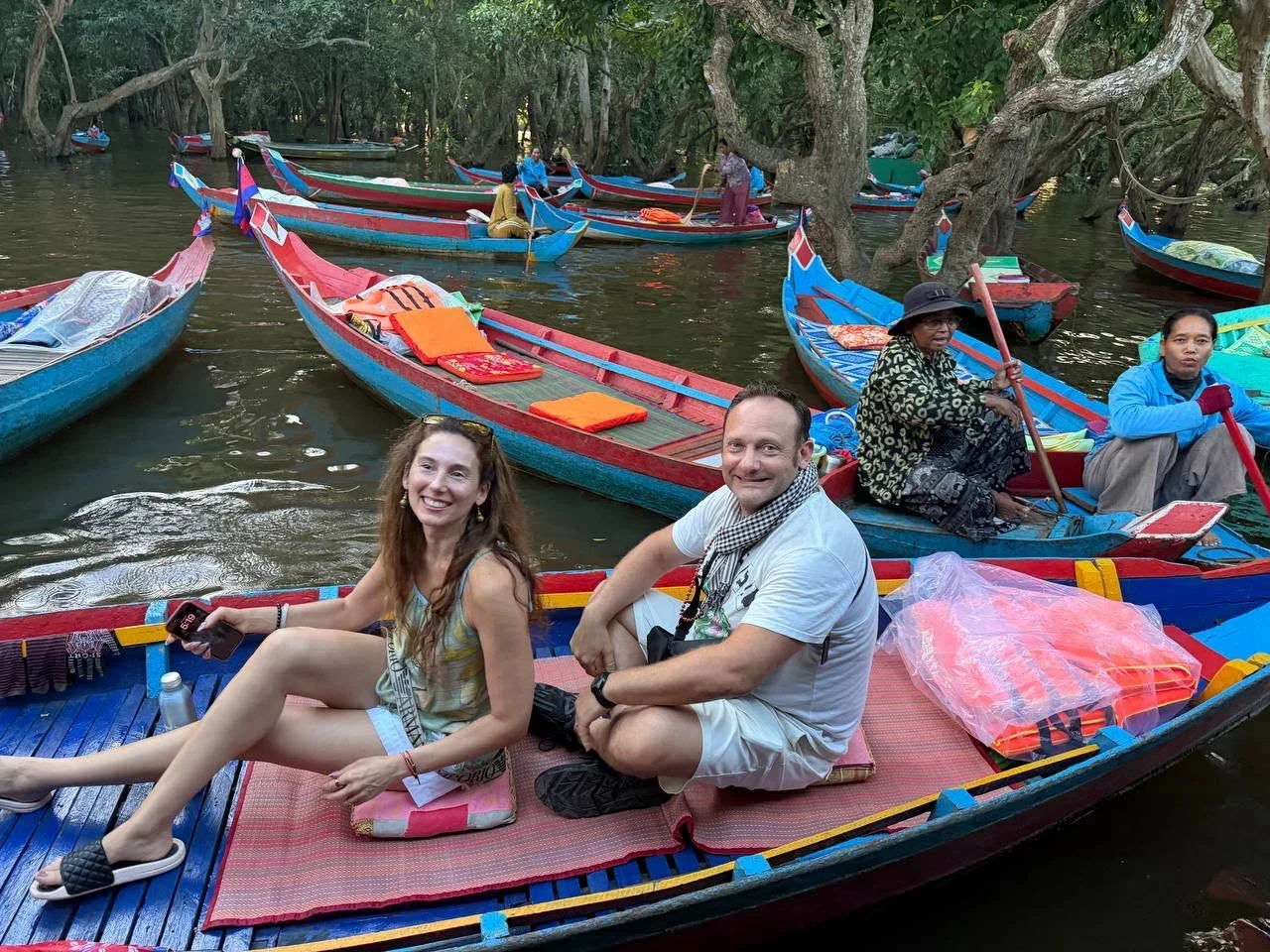

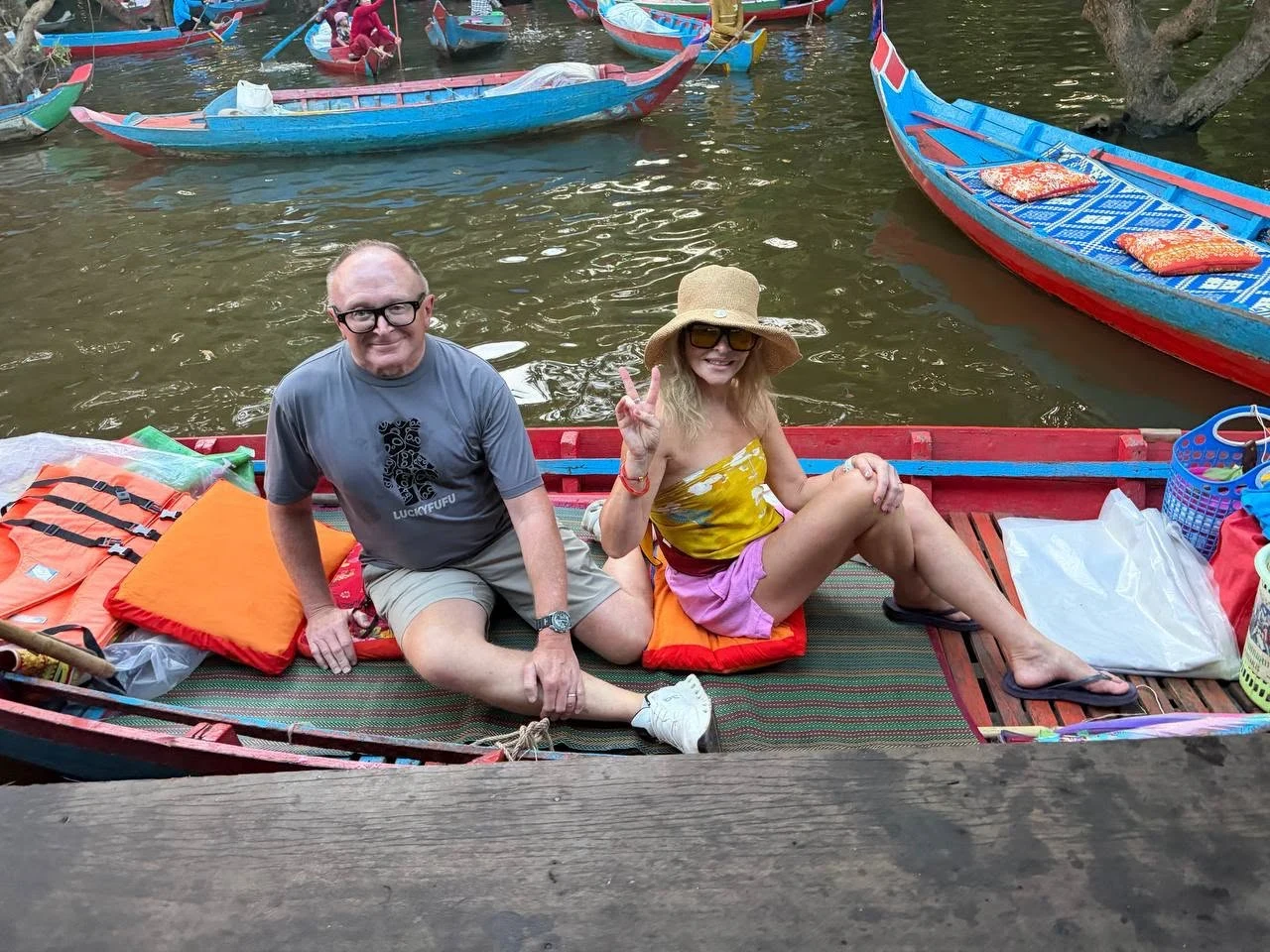

High water, no queue for the flooded forest, and a flawless sunset at Kompong Phluk
Yesterday’s Kompong Phluk Sunset Tour had everything going for it. The water is still high, up near the floors of the stilt houses, so the boat goes right between the homes and the whole village sits in the lake.
It was not too crowded, and there was no wait at all for the flooded forest: our guests stepped straight off the community boat into the rowboats and were paddled out between the trees. The weather was great all afternoon, and the sunset on the open lake was flawless.
If you are deciding when to come: early November is about as good as it gets at Kompong Phluk. The forest is still fully flooded, the rains have eased, and the skies are clearing for sunset.
Frequently asked questions
Is Kompong Phluk worth visiting?
Yes. It is the most photogenic of the Siem Reap villages because of the stilt houses and the flooded forest, and it is far less crowded than Chong Kneas. The ideal months are August to early December, but there is water year-round and the boat trip is good in any season.
Kompong Phluk or Kompong Khleang?
Kompong Phluk has the most easily accessible flooded forest and is closer to Siem Reap. Kompong Khleang is larger and more remote; it is mostly stilt houses too, with floating homes and two entirely floating villages near the lake. If you only have one afternoon, Phluk; if you want fewer tourists, Khleang. Which floating village is best for you? Our full comparison →
How much does it cost to visit Kompong Phluk?
The village boat is USD 20 per person plus a USD 2 tourism tax and the forest rowboat USD 5. Add transport from Siem Reap (about $15–25 for a tuk-tuk, more for a car) and the total is around $40–50 on your own, which is why our $28 group tour with transport, guide and both boats included is the usual choice.
How long does a visit take?
About 2 hours in the village and forest, plus around 45 minutes each way by road. Our half-day tour runs 4.5 hours door to door.
Can you visit Kompong Phluk in the dry season?
Yes. The village is reached by road, the stilts are fully exposed, and you can walk through it. The forest rowboats do not run when the water is low, usually February to June, when the water is lowest.
Is the tour suitable for children and older travelers?
Yes. The boats are stable and there are life jackets in both the main boat and the canoes. Children under 12 get USD 10 off and under-2s travel free. Boarding involves a few wooden steps; walking sticks and bad knees are fine, wheelchairs are not recommended.
Is it Kompong Phluk or Kampong Phluk?
Both are the same village. Khmer has no single official spelling in English, so you will see Kompong Phluk, Kampong Phluk and Kampong Pluk on maps, tickets and booking sites. Kompong (or Kampong) means a landing place or port on the water.
What should I bring?
Sunscreen, a hat, water (we provide it on our tours), cash in small USD or riel for snacks, and modest clothing for the pagoda stop.